
HIPAA-compliant Application
Built-in PHI protections and access controls.

Patient portals, telehealth platforms, and EHR integrations engineered to HIPAA Security and Privacy Rules — security and compliance at every layer.
Six specialist disciplines covering every layer of healthcare technology delivery.
End-to-end encryption, audit logging, access control, and data residency built to meet HIPAA Security and Privacy Rules from day one.
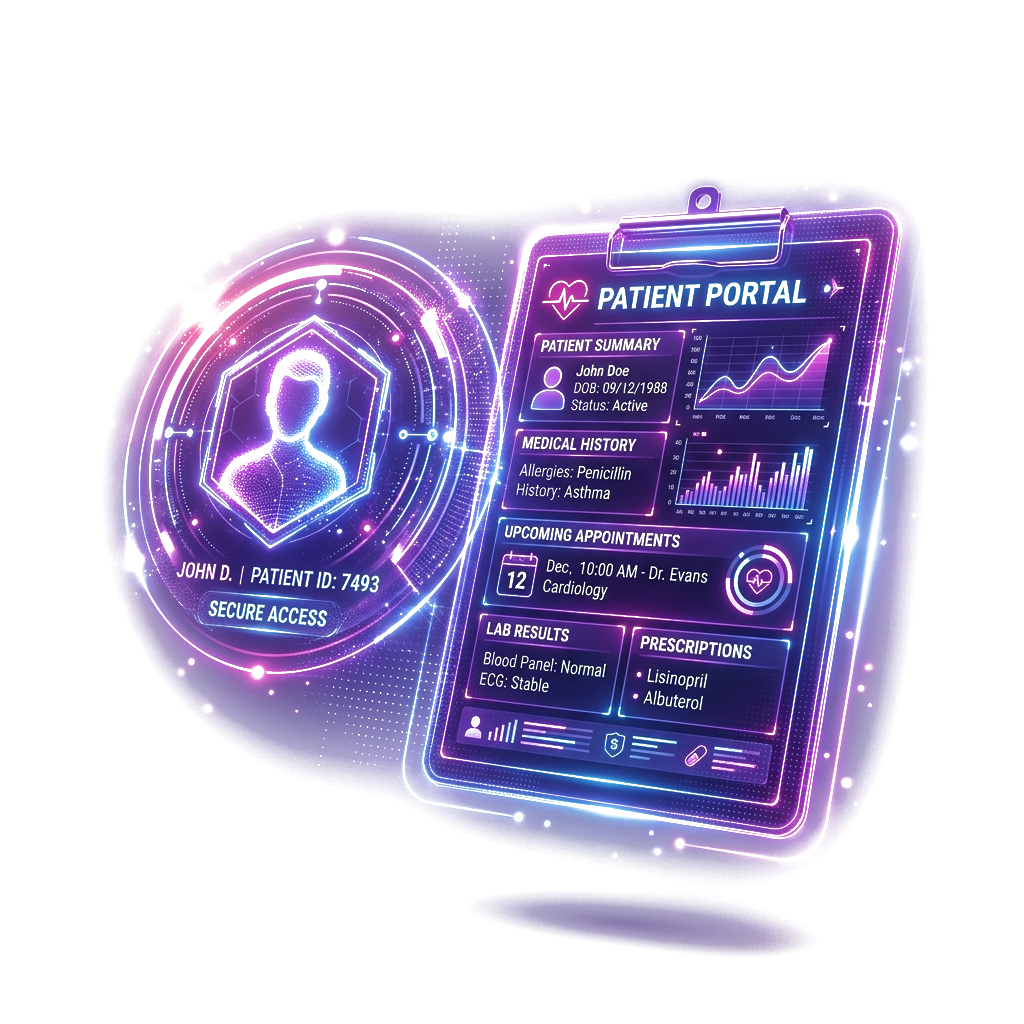
Secure portals with appointment scheduling, medical records, prescription management, and encrypted messaging.
WebRTC video consultations with HIPAA-compliant recording, e-prescribing, and real-time patient queue management.






Bidirectional data exchange with Epic, Cerner, and other EHR platforms via HL7 FHIR R4 APIs, with full audit trails.
iOS and Android apps for patients and clinicians: medication reminders, symptom trackers, appointment tools, and secure clinical messaging.
Predictive risk stratification, NLP for clinical documentation, and ML diagnostic support — all audit-ready.
The most costly architectural risks healthcare organisations face when scaling digital platforms.
HIPAA violations can cost up to $1.9M per incident. Most platforms treat compliance as a checkbox, not architecture — leaving organisations exposed.
Legacy HL7 v2 and proprietary EHR APIs create brittle integrations that break on every vendor update, consuming engineering cycles and delaying launches.
Healthcare data is the most targeted in ransomware attacks. Perimeter-only security fails against insider threats and sophisticated adversaries.
Concrete technical answers to the compliance, integration, and security challenges your business faces.
Data residency, encryption at rest and in transit, role-based access control, and BAA-ready infrastructure baked into every layer — not bolted on.
Typed API adapters for Epic, Cerner, and other EHRs with automated compatibility tests and bidirectional data exchange with full audit trails.
Role-based access control, audit logging, session management hardened from day one, and annual penetration testing — delivered with every project.
Built-in PHI protections and access controls.
Strict granular permissions and activity tracking.
Bidirectional data exchange with major EHRs.
AES-256 at rest and TLS 1.3 in transit.
Inclusive design for all patients and clinicians.
Independent verification of system integrity.
Fully compliant partner network and infrastructure.
Ongoing oversight for evolving regulations.
Answers to common questions about HIPAA compliance, EHR integrations, and patient data security.
Yes. We sign BAAs as part of every healthcare engagement. All third-party services used in the stack (cloud providers, databases, analytics tools) are selected for BAA availability so your entire data environment is covered.
We integrate with Epic, Cerner, Meditech, and other EHR platforms via HL7 FHIR R4 APIs. We build typed, tested adapter layers so integrations survive vendor updates without breaking your application.
We implement a zero-trust architecture — AES-256 encryption at rest and in transit, role-based access control, session timeout enforcement, audit logging of all PHI access, and annual penetration testing on every production environment.
Yes. We integrate WebRTC video consultations, HIPAA-compliant session recording, e-prescribing, and appointment scheduling into existing applications — without requiring a platform rebuild.
Share your compliance requirements and we will scope a HIPAA-ready architecture.